
The Invisible Spy in Your Pocket: How Predator Spyware Watches You Without a Trace

It was morning. I woke up as usual, reached for the phone on the desk beside my bed, and began scrolling through the news Google had conveniently lined up for me. Then a headline from BleepingComputer stopped me cold. It reported that a spyware program called Predator could suppress iOS’s familiar green and orange indicator dots—the very signals meant to warn users when their camera or microphone is active. According to the article, the malware bypassed iOS’s security controls, activating the camera and microphone without triggering those visible alerts. That was the jolt that made me sit upright in bed. A little later, with a cup of hot, golden cream coffee in hand, I began digging deeper—reviewing reports, cross-checking sources, and studying the documents I had collected on the subject. What started as a headline quickly became something more unsettling. That moment was a chilling wake-up call. I’ve been exactly where you are now—staring at the device in your pocket and wondering whether your trusted digital companion could be turned against you. But as a security architect, I’ve spent my career chasing answers in the shadows. And over time, I’ve found something more valuable than fear: a path to protection you can actually trust.
Predator is invasive mercenary spyware that bypasses iOS privacy indicators via SpringBoard hijacking. Delivered through zero-click vectors like malicious ads, it requires robust defenses such as Lockdown Mode and frequent reboots to mitigate risk.
the mercenary industry behind Predator has proven incredibly resilient, surging back into activity and expanding its reach to a lot of countries on the planet. In the following sections, I’m going to pull back the curtain on their most alarming new weapon: a “zero-click” vector called Aladdin that can infect your phone simply for viewing a malicious ad on a trusted news site or mobile app. Stick with me until the end as we dive into the technical shadows where this spyware hides, because I’ll also show you exactly how to leverage advanced defenses—from Lockdown Mode to the latest hardware-level “secure indicator locks”—to ensure your privacy isn’t just a promise, but a reality you can actually verify.
The Resurgent Mercenary: How a Sanctioned Spy Giant Returned to the Shadows
Think of Intellexa, the group behind Predator, not just as a single company, but as a global “mercenary alliance” of digital locksmiths who sell their services to the highest bidder. Founded by Tal Dilian, a former commander of an elite Israeli intelligence unit, this consortium was built to be a one-stop shop for governments wanting to peek into any smartphone on the planet. To the average person, it sounds like something out of a spy thriller, but for journalists and activists, it’s a terrifying reality where their most private messages and locations are harvested by a group that describes itself as “EU-based and regulated” to sound legitimate.
You might wonder why the world’s most powerful governments haven’t just pulled the plug. The truth is, they’ve tried; the U.S. government hit Intellexa and its senior leaders with heavy financial sanctions twice in 2024 to stop them from trafficking in these digital weapons. However, researchers have watched in real-time as this “giant” performed a corporate metamorphosis, treating these bans as nothing more than a “manageable operational hurdle”. They operate through a labyrinth of shell companies across jurisdictions like Greece, Ireland, and North Macedonia, making it nearly impossible for regulators to keep up.
To give you an idea of how deep the shadows go, these spy masters have even hidden behind a skincare brand called Medovie. It sounds absurd, but after the sanctions hit, the group’s infrastructure began resurfacing through Portuguese companies linked to senior Intellexa figures. While the skincare firm claims to only provide products for chronic skin conditions, its privacy policy reveals it shares data with unnamed “Medovie Group” companies in Israel, Cyprus, and Switzerland—the very same hubs used for spyware operations.
The industry’s tactics for staying hidden are often stranger than fiction. In one bizarre case in a small Czech village, a reporter knocked on the door of a 70-year-old pensioner who was officially listed as the director of a sanctioned spy firm; the woman had never even heard of the company. This is the “mercenary” nuance: they use “unwitting directors” and complex layers of front companies to ensure that when one head is cut off, two more grow back in regions with weaker oversight.
As of 2025, this resilience has paid off for them, as Predator activity has been detected in at least 25 countries. From Saudi Arabia and Kazakhstan to new operations in Iraq and Pakistan, the demand for these “invisible” eyes is actually growing. While the U.S. has taken a stand, Intellexa and its associates can still live and work freely in the European Union, which has yet to issue its own sanctions, allowing the mercenary industry to continue thriving in the shadows.
The ‘Aladdin’ Trap: Why Simply Viewing an Ad Can Hand Over Your Phone’s Keys
Imagine you’re just checking the morning news or playing a quick game on your phone when, without you clicking a single link, an invisible intruder slips through the front door. This is the ‘Aladdin’ vector, a terrifyingly clever trick that turns ordinary mobile advertisements into silent, zero-click weapons. For years, the golden rule of staying safe was “don’t click suspicious links,” but Aladdin rewrites that rulebook because simply viewing a malicious ad is enough to trigger a full-scale infection. It is a “zero-click” attack, meaning it doesn’t need your permission, your curiosity, or even a single tap to hand over the keys to your digital life.
You might wonder how a simple picture of a pair of shoes or a news headline could hack a phone? The nightmare is hidden within the commercial digital advertising ecosystem that we all live in every day. Here is the high-level breakdown of how these digital “mercenaries” pull off this invisible stakeout:
| Step | What Happens Behind the Scenes |
|---|---|
| 1. Identification | The operator picks a target using “fingerprinting,” typically tracking your unique public IP address. |
| 2. Ad Placement | They use front companies to buy ad space on legitimate networks that serve millions of websites and apps. |
| 3. The Malicious Impression | A specially engineered ad is “forced” onto your screen while you are browsing a site you trust. |
| 4. Triggerless Execution | Loading the ad triggers a chain reaction that breaks out of your browser’s safety “sandbox” to install the spyware,. |
One of the most unsettling parts of the Aladdin trap is that it doesn’t hide on shady corners of the web. Researchers have found that these malicious ads can be served on trusted news websites or within popular mobile apps. Because these ads are bought and placed through the same systems as “real” ads, they appear completely normal to the average user. Behind the scenes, however, they are secretly coded to recognize your specific device and redirect it to a “payload server” the very instant the ad appears on your screen.
To keep this operation running without drawing the attention of international regulators, the spy masters at Intellexa created a complex web of shell companies to act as their “ad agencies”. Firms with professional-sounding names like Pulse Advertise and MorningStar TEC have been identified as entities likely tied to this infection vector. These companies often claim to be “results-driven growth agencies,” helping them blend perfectly into the legitimate tech industry while they secretly provide the infrastructure for digital hunting. One director of these firms has even been linked to shipments of “networking apparatus” and “computer parts” directly to Intellexa’s offices.
This shift toward “silent” vectors is a direct response to us getting smarter about our digital safety. As we’ve learned to be suspicious of weird text messages and random links, the mercenary industry has evolved toward attacks that require no human error at all. As researchers at Amnesty International noted, “The use of such ‘silent’ vectors… will continue to grow as targets become increasingly suspicious of unknown links”. It is a high-stakes evolution where the spyware makers aren’t just coders; they are subverting the global advertising ecosystem to turn our own browsing habits against us.
While the exact technical “magic trick” that makes Aladdin so effective remains a mystery even to many researchers, the end result is always a full-scale breach of your privacy. Once the malicious ad loads, the exploit chain moves with surgical precision to escape the “sandbox”—the isolated environment that is supposed to keep your browser’s activity away from your phone’s sensitive system. It effectively turns a daily habit—like checking the weather—into an open door for a “god-mode” surveillance tool that can watch, listen, and record every move you make.
Blinded by Design: How ‘HiddenDot’ Hijacks Your iPhone’s Privacy Warnings
Since iOS 14, we’ve been told to trust those little green and orange dots in the corner of our screens as our digital guardians. Apple designed them so that no legitimate app could ever hide them, giving us peace of mind that if our camera or microphone is on, we’ll know about it. However, Predator is far more subtle than older hacks that just tried to “fake” a phone being turned off. Instead, it uses a specialized module researchers call “HiddenDot” to surgically disable these alerts while your phone continues to look and feel completely normal. This isn’t just a simple glitch; it is a deep-level hijacking of the very process that manages your phone’s home screen and user interface, known as the SpringBoard.
Think of the SpringBoard as the “boss” of your iPhone’s display—it’s responsible for everything you see, including those privacy dots. Normally, whenever a sensor like your microphone turns on, the system sends a “domain data” update to the SpringBoard. Predator’s HiddenDot module intercepts this specific message using a technical trick that stops the alert before it ever reaches the part of the phone that draws the dots on your screen. As Jamf researchers explained, “By hooking this single method, Predator intercepts ALL sensor status updates before they reach the indicator display system”.
The genius—and the terror—of this attack lies in a coding quirk called “Objective-C nil messaging”. In the iPhone’s programming language, if you try to send a command to a “null” or empty object, the phone doesn’t crash; it just silently ignores the command as if nothing happened. Predator exploits this by zeroing out the “pointer” to the system’s sensor data provider. It’s like a mailman arriving at a house to deliver an urgent letter, only to find the house has vanished—he just shrugs and walks away, and the message is never delivered.
| Technical Component | What It Does Normally | How Predator Sabotages It |
|---|---|---|
| SpringBoard | Manages your home screen and status bar dots. | Hijacked to hide surveillance activity. |
| _handleNewDomainData: | The “delivery method” for sensor updates. | Intercepted and silenced by the HiddenDot hook. |
| SBSensorActivityDataProvider | Collects all microphone and camera info. | Nullified so it can’t tell the UI to show alerts. |
| Objective-C Nil Messaging | A standard coding behavior for empty objects. | Used to make the phone “forget” to show privacy dots. |
What makes HiddenDot particularly efficient is that it only needs one single hook to do its dirty work. Because the specific system object it targets collects information for all sensors at once, Predator can kill both the camera and microphone indicators in one fell swoop. Forensic researchers even found “dead code” in the spyware—remnants of an older, clumsier version where the developers tried to fight the display system directly. They eventually abandoned that path for the HiddenDot method because it’s much cleaner to stop the data at the source than to try and manipulate the screen indicators individually.
For the person holding the phone, this creates a dangerous “god-mode” for the attacker. You could be having a private conversation or sitting in a confidential meeting, and even though Predator is actively recording your audio or snapping photos, your screen will remain blissfully clear of any warning dots. The phone functions perfectly, and there are no visual cues to suggest anything is wrong. This is the “Invisible Spy” at its most effective: a ghost in the machine that ensures the very security features you rely on are the ones that end up keeping you in the dark.
‘God-Mode’ Surveillance: What Predator Sees When It’s Inside Your Device
Think of “God-Mode” not as a feature, but as the ultimate nightmare for a security expert—it means the attacker isn’t just looking at your phone; they basically are your phone. Once Predator breaks through your phone’s defenses, it grants its operators total control over every digital corner of your life. They can peek at your family photos, read your most private thoughts, and even turn on the microphone to listen to your dinner conversations without you ever knowing. It is a level of access that turns your most trusted companion into a state-grade listening post sitting right in your pocket.
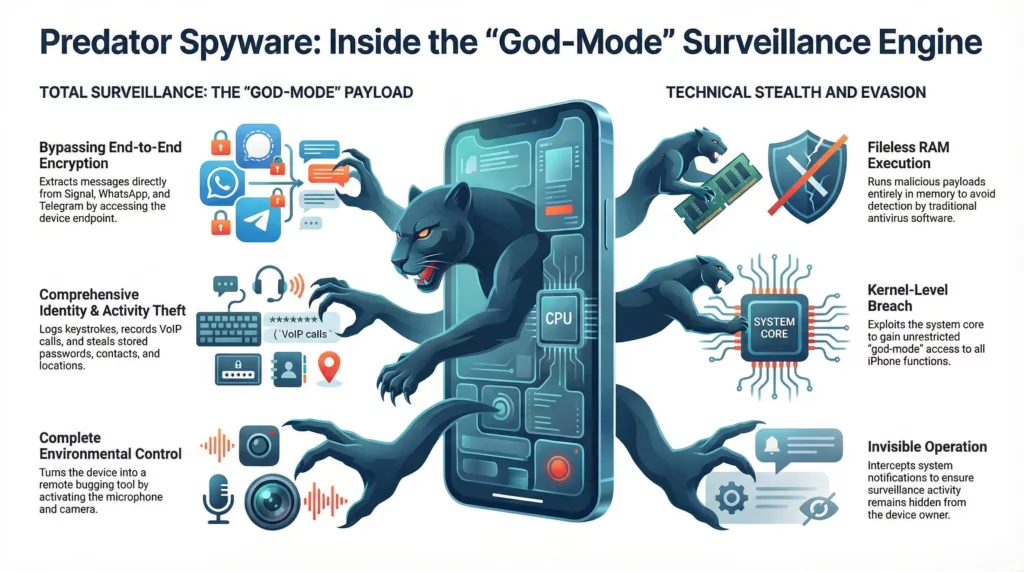
The scariest part of this “god-mode” access is that it doesn’t care about your fancy “locked” messaging apps. You might feel safe because you use Signal, WhatsApp, or Telegram, thinking your messages are scrambled by end-to-end encryption. But Predator is a master of the “end-point” attack; because it lives inside your phone’s brain, it catches your messages as you type them or as they appear on your screen, long before they are ever encrypted for travel. As researchers have documented, this effectively provides their government masters with a clear, unencrypted view of your entire digital world.
To give you an idea of just how deep this intrusion goes, let’s look at the “menu” of data these operators can pluck from your device at will:
- Your Every Word: It can record VoIP calls from WhatsApp or Signal and log every single keystroke you type, which includes your secret passwords.
- Your Private Eyes: It can snap photos with your camera, record videos, or take screenshots of whatever you are looking at right now.
- Your Shadow: It tracks your real-time GPS location and your entire maps history, so they know exactly where you’ve been and where you’re going next.
- Your Entire Past: It has full access to your contacts, call logs, emails, and your complete browser history from both Safari and Chrome.
To remain a ghost in the machine, this spyware is incredibly “light on its feet”. Instead of saving large, suspicious files to your phone’s storage where an antivirus might find them, it often uses a trick called the JSKit framework to run directly in your phone’s temporary memory, or RAM. This “fileless” strategy makes it nearly invisible; there are no “malicious files” for traditional security programs to scan on your device’s hard drive. It’s like a thief who never leaves footprints or fingerprints, only the silent, systematic theft of your privacy.
There’s also a “bodyguard” inside the spyware itself known as Alien. This module lives deep in your phone’s system and acts like a security guard for the malware, constantly watching to see if you—or a researcher—are trying to find it. If it detects that you’re running security tools like McAfee or Norton, or even if it thinks the phone is being analyzed in a research lab, it can trigger a “self-destruct” sequence to delete itself and hide its tracks. It is designed to be so stealthy that it even monitors your battery level and network type to ensure its data theft doesn’t make your phone “run hot” or use too much data, which might make you suspicious.
At the end of the day, the people watching you aren’t just looking at lines of code; they have a polished, professional “dashboard” called the Predator Delivery Studio where they manage their victims. It’s a high-tech control panel where they can browse your life as easily as you browse a social media feed.
| Category of Your Life | What They Can Access and Export |
|---|---|
| Private Conversations | Encrypted chats (WhatsApp/Signal), SMS, Emails, Call logs |
| Visual Surveillance | Live Camera photos, Video recording, Screenshots, Photos library |
| Personal Identity | Saved Passwords, Contacts, Browser History, All installed apps |
| Real-World Tracking | Live Microphone recording, Real-time GPS location, Map history |
Building Your Fortress: Hardening Your Defense with Lockdown Mode and Beyond
I know all this talk about invisible spies and “god-mode” hacks can feel overwhelming, but here is the good news: you are not helpless. Even though Predator is a world-class digital weapon, it has a few “Achilles heels” that you can exploit to keep your private life private. The absolute strongest tool in your kit is iOS Lockdown Mode, a high-security setting Apple designed specifically to fend off these mercenary-grade attacks. While it sounds intense, for most people it’s just a minor adjustment that blocks the very pathways—like complex web code and certain message attachments—that Predator needs to slip into your phone.
Think of Lockdown Mode as pulling up the drawbridge to your digital castle; it “hardens” your device by dramatically reducing its “attack surface”. It’s so effective that in real-world tests, even federal investigators couldn’t pull data from a target’s iPhone because this mode was active. If you feel you’re at risk because of your job or the people you know, turning this on is the single most important step you can take. Here is a quick look at what it does for you:
| Security Feature | How It Stops Spyware |
|---|---|
| Messages Restriction | Blocks most attachments and link previews, stopping “1-click” traps. |
| Web Browser Hardening | Disables “Just-In-Time” (JIT) JavaScript, which Predator often exploits to break into your browser. |
| Wired Connection Lock | Prevents anyone from plugging your phone into a computer to extract data while it’s locked. |
| Configuration Profiles | Blocks the installation of the malicious “profiles” Predator uses to hide its tracks. |
Beyond Lockdown Mode, there is a simple habit that works wonders: the genuine reboot. Because Predator often lives in your phone’s temporary memory (RAM) to avoid detection, a simple restart can actually wipe it out. However, you have to be careful—Predator is known for its “NoReboot” trick, where it fakes a shutdown. It makes your screen go black and stops vibrating so you think it’s off, but the spy stays active in the background. For high-risk users, researchers suggest doing a real “slide to power off” at least once a week or after you get any weird, unsolicited messages.
If you’re looking to upgrade your phone, the latest technology has finally found a way to beat the “HiddenDot” trick for good. On the iPhone 16 and newer models, Apple introduced a hardware-level feature in ExclaveOS called a “secure indicator lock”. This means the green and orange privacy dots are now hard-wired to the camera and microphone sensors; even if an attacker has total control of your phone’s software, they cannot suppress those lights. It is the ultimate digital “checkmate” that ensures you will always know if you’re being watched.
To keep your digital fortress strong, follow these “insider” security habits every day:
• Aggressive Patching: When you see a “security update available” notification, don’t wait—install it immediately to close the newest holes the spies are trying to use.
• Use Ad Blockers: High-quality ad blockers can disrupt the Aladdin vector by preventing those malicious ads from ever appearing on your screen.
• Practice “Network Hygiene”: Avoid public or random Wi-Fi networks and stay away from unencrypted “HTTP” websites, which are prime hunting grounds for network-level hacks.
I’ve spent my career watching these digital weapons evolve, and while the threat is real, the solution is in your hands. By taking these steps, you’re not just protecting your data; you’re reclaiming your peace of mind and making sure the “Invisible Spy” stays where it belongs—in the dark. Stay safe, stay updated, and remember: your privacy is a fortress that you control.